Germany and Europe: On a fatal Path

From my Writing Room
Copyright © 2024 by Uwe Bahr

On the second anniversary of the war in Ukraine, German Chancellor Olaf Scholz chooses strong words. And he is obviously forgetting the successful policies of his own Social Democratic Party not too long ago.

Not without a small pinch of uncertainty, Scholz told his fellow citizens in all seriousness yesterday: “A return to the policy of deterrence was necessary. Words such as ‘deterrence’ and ‘defense readiness’ are unfamiliar words for some [people] coming from a German Chancellor. However, they stand for an important task: Together with our allies, we must be so strong that no one dares to attack us. This is how we ensure our security. And this is how we defend peace in Europe.”

German Chancellor Olaf Scholz (Social Democratic Party of Germany).

He is thus contradicting the spirit of all reason and history, from which the Germans in particular should have learned their lessons. For it is not difficult to see that his statements will only lead to an endless spiral of rearmament and further deaths, including the mutual waste of resources affecting generations to come – for the other side will of course respond with the same.

Recent history teaches a different path, which was successful and ultimately led to the – temporary – end of the division of Europe, the Cold War. The West German policy of détente in the 1960s/70s, often to the annoyance of the Americans at the time, led to de-escalation in small steps, although wars were also the order of the day back then. The Soviets subjugated the entire Eastern Bloc, and a Leonid Brezhnev as the leader of the Communist Party of the Soviet Union, in World War II allied with the USA, was anything but an easy negotiating partner – certainly worse than a Putin in the first decade of our century. But at least the channels of communication between the two power blocs always remained open, even during the Cuban Missile Crisis in 1962.

The certainty has long since solidified that an economically and socially staggering Germany today no longer pursues an independent foreign policy, but has made itself the vassal of interests that cannot be German interests.

Instead of submitting unconditionally, the Europeans, led by France and Germany, should form their own protective alliance, which represents the interests of Europe and not those of the USA. France has nuclear weapons, France and Germany together have more people than Russia, a higher economic power than Russia and a higher military budget than Russia. If a deterrent were needed, the potential for it would be in European hands and not in the hands of the USA, which does not want to grant a fair partnership based on reciprocity.

The reaction of the USA would remain to be seen if they no longer had their hands in the pie everywhere in order to expand their influence and their quest for endless profit.

For the USA is not a protective power, but an aggressive world power that is exclusively pursuing its own expansionist interests. It has proven this fact with its senseless wars, interventions and bombings throughout its history.

Such a country cannot lead a defense alliance.
When the West was still negotiating

Energy agreements with other despotic regimes now replace Russia

From my Writing Room
Copyright © 2023 by Uwe Bahr

When it is claimed on current occasions – in my home country even more vehemently than elsewhere – that Germany has made itself too dependent on Russian natural gas for decades, then these claims do not stand up to historical evidence. All the more so when this is compared to other countries, and here again in particular to the USA.

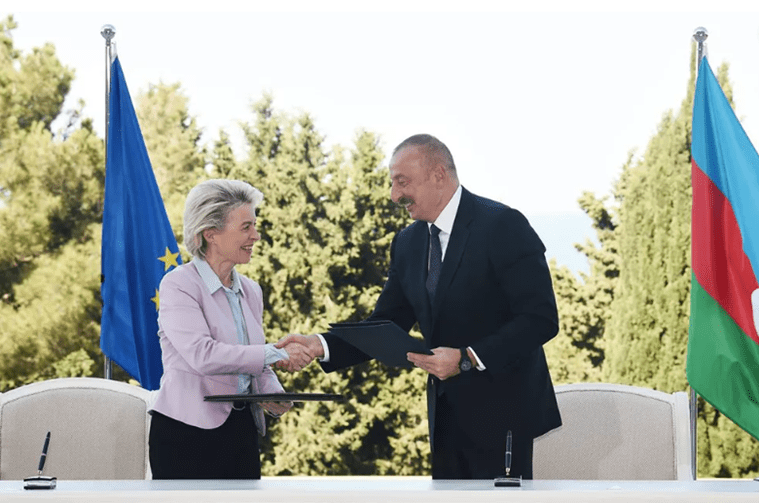
Friendly handshake with a despot. European Union Commission President Ursula von der Leyen and Azerbaijani President Ilham Aliyev on July 18, 2022, at the signing of the energy agreement in Baku. Azerbaijan has an authoritarian form of government, there are no free and secret elections, political opponents are arrested, and human rights violations are commonplace. – Azerbaijan is only one of several authoritative states with which Germany in particular has reached agreements as a substitute for Russian natural gas and oil.

For about 100 years, America has been obtaining most of its primary source of raw materials – crude oil – from other parts of the world, namely from countries that can be described as politically unstable at the very least and where human rights violations are a daily occurrence. Even wars against international law do not keep the USA and other NATO countries from maintaining friendly economic relations with despotic regimes, such as Saudi Arabia, which has been waging a criminal war in Yemen for years with the support of the Americans.

In contrast to Ukraine, there is no international outcry here, although according to estimates, far more than 100,000 people have died in Yemen so far as a result of the effects of the war. And just last summer, the European Union reached an agreement with Azerbaijani despot Ilham Aliyev, under which the country would double its natural gas supplies to Europe by 2027. The double standard is not only shocking, but shameful.

Doesn’t all this entail the risk of dependency on regimes that are anything but democratic and where it is at least uncertain how they will develop?

But there is an essential difference: Germany, as a country poor in raw materials, must solve its current energy problems diplomatically, while the Americans resort to their intelligence services when things do not go the way of U.S. interests. If it is not enough to establish puppet governments according to their wishes, they then march in with the most highly armed military in the world to ensure “democracy and freedom” appropriate to their own ideas and interests – see Afghanistan and Iraq. The list of American interventions around the world is long – no less than 251 times since 1991, the USA created its own facts using force.

It is a mistake, which can have disastrous effects, to always look at things only from one’s own point of view. The American invasions of Afghanistan and Iraq are on par with the Russian invasion of Ukraine. Not wanting to admit to this and supporting one, aggressive side while condemning the other is a classic example of double standards. Such an approach certainly does not contribute to an objective assessment of events. But this is the intention of those who set the tone and mislead their own people, for they naturally want to conceal the true motives.

Those who today in all seriousness allege that Germany over the cause of decades had become too dependent on Russia in the energy question are at the same time ignoring a policy of balance and détente that proved successful at the end of the 1960s and especially in the 1970s. It is therefore worthwhile, in the sense of forming a realistic opinion, not to spare the effort of following the chronology of events, at least in broad outline. Nazi Germany’s war in the Soviet Union had cost up to 27 million lives there. In view of the war trauma, it was especially important in the postwar years to conclude economic agreements as part of the reactivation of relations between the two countries in order to create an initial basis for mutual understanding. This purpose was served not least by the natural gas and oil contracts with the then Soviet Union. Both German states profited from this, whereby it is remarkable at what far more favorable conditions an ideological opponent sold its raw materials to Germany and Europe for over 60 years than the great ally USA does today.

It is hard to deny that contrary to all the prophecies of doom at the time – even from me, who was still very young at the time – this policy of dialogue led to a softening of hardened fronts in the middle of the Cold War. And this aspect was not the only important factor: for without this policy of détente, German reunification would hardly have been possible. This is historical evidence of how peaceful negotiations to establish a basis of trust while respecting mutual security interests in the former Soviet-subjugated Eastern Bloc countries ultimately led to freedom and democracy. It was not war and more and more weapons that eventually led to peaceful coexistence, but the will to talk to each other.

In other words, negotiations have been held with the opponent instead of refusing to negotiate.

If you look around today, you are bound to notice the frightening extent to which almost all Western politicians ignore these virtues. The nice Mr. Biden is the highest representative of a supposedly democratic leading power, but he does not want to negotiate with Russia, even for the hope of preventing further senseless victims in Ukraine, as well as a possible horror scenario with nuclear weapons. One has to imagine that. Instead of firmly objecting to its great friend in Washington, the whole of Europe has submitted to the sanctions imposed by the Americans on Russia, simply because the Americans think of nothing else but their own interests.

The damage is being borne by Europeans, while the U.S. and the internationalized corporations it controls are the only ones profiting from the war in Ukraine.