With Stones Against Russian Tanks

Long before the Berlin Wall was built, the Soviet satellite state of East Germany was doomed to fall

From my Writing Room
Copyright © 2023 by Uwe Bahr

Seventy years ago, on June 17, 1953, about one million people took to the streets in the Soviet-occupied zone of Germany, which had been called the “German Democratic Republic” (GDR) since 1949. They demonstrated against the poor supply situation and, above all, against the ordered norm increases for workers without wage compensation. During the uprising, political demands were added: free and democratic elections and the restoration of German unity.
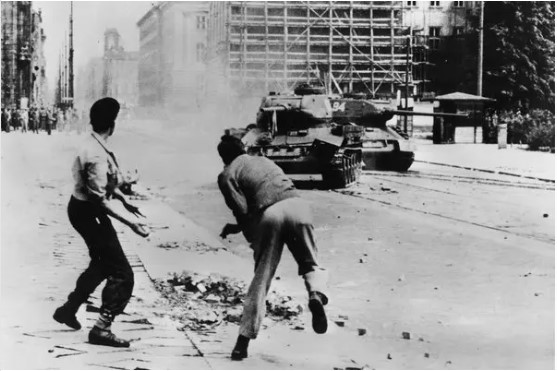
For a few hours on June 17, 1953, the communist leadership in East Berlin had lost all control over the GDR. Then the Soviet tanks came and crushed the workers’ uprising. More than 100 people lost their lives.

No help came from the West.

While GDR citizens defended themselves against Soviet tanks with stones and sticks, head of state Walter Ulbricht and his communist comrades had to flee to the custody of the Soviet military administration in Berlin-Karlshorst. For a few hours, the GDR, which was not even four years old, was actually already destroyed. The West stood idly by during these days, as it did later during the building of the Berlin Wall, and indeed could not help. For any active interference would have triggered a military confrontation with the Soviet Union including unimaginable consequences.

Thirty-six years later, GDR citizens again took to the streets against the Stalinist system – and in peaceful protests they were successful this time, eliminating the SED regime of injustice and making the reunification of Germany possible in the first place. When the Berlin Wall fell, Soviet tanks stayed in the barracks, while the Western powers, who held the protection of West Berlin, did not dare to intervene openly. As a contemporary witness, I saw myself in disbelieving amazement at this – then, as now. The Soviets at the End of the Cold War had their own difficulties, mainly of economic nature – that’s true, but they were still a nuclear power and could have reacted very differently in the fall of 1989.

Today, there are politicians in Germany who, in their unquestioning allegiance to the U.S., want to certify directly or indirectly to the same former East Germans who brought down the Cold War that they sympathize with today’s Russia and Putin out of “nostalgic attachment” to the former Soviet Union. This is the reason why fewer people in the German East allegedly support the war in Ukraine against Russia than in the West.

How is that possible? Those who actively opposed the totalitarian occupying power back then now all of the sudden feel sympathy for it in the aftermath? There can hardly be a greater contradiction. Or are they perhaps the ones who can see through the mendacious policy of the West because of the experiences they made in two German states? Do they still feel gratitude? Without Gorbachev and his relenting there would probably not have been a German reunification. In Gorbachev’s back, as is often forgotten today, Stalinist die-hards were ready to undo history, as the attempted coup in the Soviet Union in the summer of 1991 proves. At that time, hundreds of thousands of Soviet soldiers were still stationed in the East of the reunited Germany, the last of whom did not leave until 1994.

It is an impertinence beyond compare when people with a lack of expertise assume the right to judge pejoratively those who had the courage to speak out against a Stalinist dictatorship. For this, those attacked are nowadays publicly put in a corner in my home country as unruly citizens. Any opinion other than the official one does not correspond to the spirit of the times. This also shows the hypocrisy when Federal President Frank-Walter Steinmeier and others talk about events like June 17, 1953. Yet it was people like Steinmeier who courted Putin and pushed natural gas supplies from Russia – they just don’t want to talk about it anymore.

When then as now there is talk about the “evil Russians”, most commentators fail to realize that there was also a time in between, which was not long ago. Perhaps the “old GDR people”, people like me, are a bit more sensitized by their life experiences. We probably feel the new injustice in today’s system the most and understand how much the aggression policy of the USA including the eastward expansion of NATO, but especially the interferences in Ukraine, has destroyed Russia’s initially benevolent attitude towards the West.

We know who, after German reunification, failed to reach out to Russia as a partner and instead build it up as a new enemy.
Memo From Camp David

When George H. W. Bush and the German Chancellor Conferred on the Future about Germany and beyond

From my Writing Room
Copyright © 2022 by Uwe Bahr

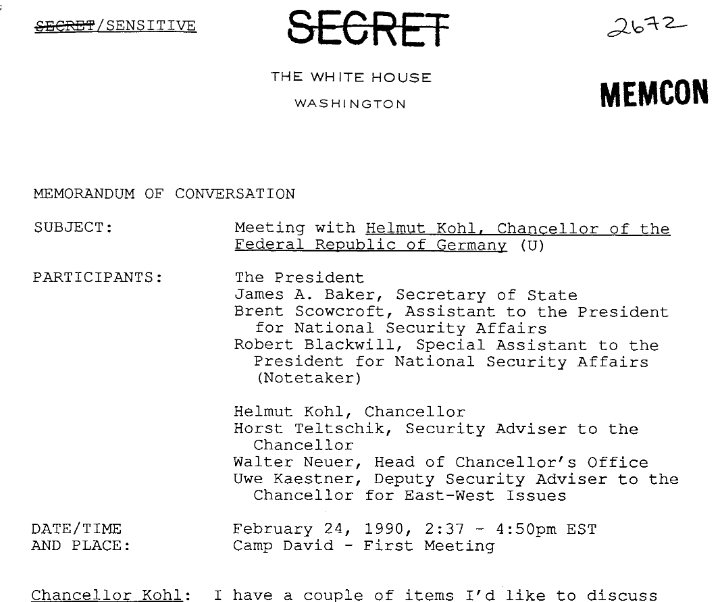
It should all happen very quickly: Three months after the fall of the Berlin Wall, Chancellor Helmut Kohl (CDU) traveled to the United States to reassure himself of American support for Germany’s future plans toward state unity.1 At a meeting at Camp David on February 24, 1990, he easily found the backing he had been hoping for from U.S. President George H. W. Bush. However, the Americans were primarily concerned not only with German reunification, but also with the expansion of NATO.

In the meantime, a public memorandum about the Camp David meeting exists and can be viewed online.2 It illustrates how, in the period immediately after the fall of the Berlin Wall, the West was keen to shift its sphere of influence together with EU and NATO to the East and closer to Russia, the legal successor of the then still existing Soviet Union.

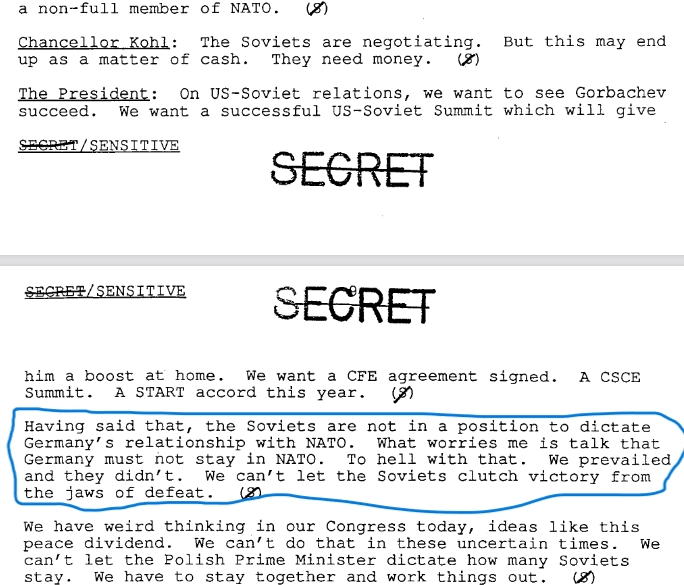
Excerpt of the memorandum of the conversation between then U.S. President George H. W. Bush and then German Chancellor, Helmut Kohl, at Camp David on February 24, 1990, released by the National Security Archive. The marked comment of the American President is telling.

In contrast, there is little sign in this conversation of plans for compromise or even peaceful coexistence with the Soviet Union within the framework of a future security structure in Eastern Europe. One participant in the conversation is intent on a possible reunification of Germany under the protective shield of the Americans; the Americans themselves see their supremacy in the world after the end of the Cold War as their most important interest in the context of “a new world order”. Both sides unfold their strategy at the expense of the disintegrating Soviet Union. The fact that the Soviets possessed nuclear weapons and that up to half a million of their soldiers were stationed in the GDR is completely ignored, as is Moscow’s reaction to the surprise opening of the Wall on November 9, 1989, which could have turned out quite differently.

I had been born and raised in the GDR, the frontline state of the Cold War, and even on the morning after the opening of the Wall, my father did not trust the situation: “The Russians will not tolerate this, they will send their tanks again.” His “again” referred to June 17, 1953, when workers’ uprisings in East Berlin and other cities had brought the GDR to the brink of collapse and the Ulbricht regime could only hold on to power through Soviet military intervention.

But this time, in the fall of 1989, the Soviet tanks and soldiers stationed on GDR soil remained in the barracks during the crucial hours. The reform policies of Mikhail Gorbachev, brought about by huge economic problems in his own country and mass protests in several Warsaw Pact states, ushered in the end of the Cold War; a development that culminated in the fall of the Berlin Wall.

Whoever looks at Europe today and sees a despicable war, which hardly anyone thought possible especially after 1989, should remember the recent historical development of the past three decades. There is no justification for Russia’s war against Ukraine – but the historical causes of the current catastrophe go back further than pointing to Europe’s and Germany’s dependence on Russian energy supplies. The terrible suffering of the affected people in Ukraine could have been prevented by more than one side if the Western powers, including Germany, had had the honest intention of building trust with the successor state of the Soviet Union instead of cornering it.

Notes:

1 Kohl had the valid fear that the chance for reunification, which had been offered to the Germans as suddenly as it had been unexpected, might not last long, so that swift action was the order of the day. This was especially true of the Soviet Union’s position, whose concession the German chancellor saw as a singular opportunity in history.

2 The published memorandum of February 24, 1990, can be read here: Memorandum of Conversation between Helmut Kohl and George Bush at Camp David. | National Security Archive (gwu.edu)

As a side note: It’s quite amusing that no small number of people in the U.S. believe Ronald Reagan brought down the Berlin Wall. In truth, Reagan did not pressure the Soviets, but took successful steps of détente with them toward disarmament, undoubtedly paving the way for what was to follow a short time later. His words at the Berlin Wall on June 12, 1987, remain unforgotten: “Mister Gorbachev, tear down this wall.” In contrast, American foreign policy under his successor, George H. W. Bush, very quickly returned to Cold War practices.

“Behind Me are Millions”

A German warning to America from History

From my Writing Room

Copyright © 2021 by Uwe Bahr

It would be a mistake to assume that Donald Trump, the mob-president, depends on the Republican Party. Instead, it must be feared that the bulk of his 74 million voters will foolishly follow him, if not within the GOP, so in any other political movement – after all, idiocy is sufficiently established in this society to serve as the trailblazer. No law will be an issue anymore.

This man with limited intellectual faculties, stricken by pathological egotism and vindictiveness, will very likely be back in public “in one form or the other”, as he himself put it in his last hours in office. America’s democracy, including a shocking number of citizens, has failed in the most despicable manner, which will result in more consequences for this country.

Of course, Trump is not Hitler, who once boasted “Behind me are Millions.” Unfortunately, it was true. And yet, the situation is insofar comparable as Trump, still supported by millions, can play cat and mouse with the Republican Party, and, as the attack on the Capitol has proven, challenge the American democracy and its institutions to the core, virtually at will and without being punished. This fact will not have escaped his followers.

In 1932 and before, when Hitler did pretty much something very similar even before he became Chancellor in the following year, the illusory “Cabinet of the Barons”, the stirrup holders of the Austrian corporal, had degraded itself to powerlessness, because after all the assurances it was now too late to do something against Hitler – for millions were following him in ecstasy, spurred on with simple paroles against the establishment. Notice something?

To be sincere: If there had not been an American 1 June 2020 (when local law enforcement cleared peaceful demonstrators from Lafayette Square) and a 6 January 2021 (when the Capitol riot occurred), any comparisons with Hitler would not have even remotely entered my mind. As an historian, like so many Americans, I would have never thought such events possible as it happened in Washington D.C.

The darkest chapter in German history will certainly never repeat itself in an American way. For this, in retrospect, not least the foreign and domestic policy accents are as different as day and night, not to mention the historical and economic situation of both countries – Germany back then and the US today. But the danger that something more entirely atypical by American political standards could happen on a grand scale, can no longer be considered impossible. Much will certainly depend on the outcome of the next elections, and also if any of the various criminal investigations against Trump as a private individual will derail him.

It is much to be hoped that Nikki Haley, former Republican South Carolina governor and UN ambassador, who broke with Trump, is right about her prophecy: that Donald Trump will not return.*

But, how does she know that?

Note: *Nikki Haley, interview with “Politico”, 12 February 2021.