Long before the Berlin Wall was built, the Soviet satellite state of East Germany was doomed to fall
From my Writing Room
Copyright © 2023 by Uwe Bahr
Seventy years ago, on June 17, 1953, about one million people took to the streets in the Soviet-occupied zone of Germany, which had been called the “German Democratic Republic” (GDR) since 1949. They demonstrated against the poor supply situation and, above all, against the ordered norm increases for workers without wage compensation. During the uprising, political demands were added: free and democratic elections and the restoration of German unity.
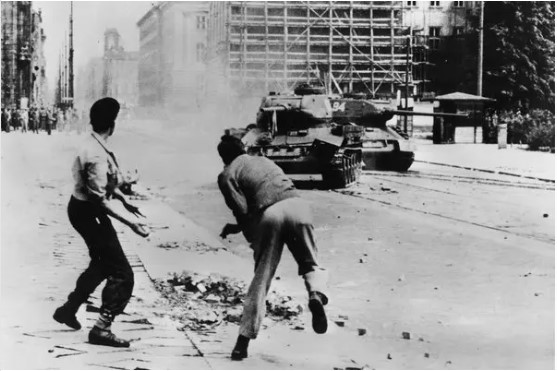
No help came from the West.
While GDR citizens defended themselves against Soviet tanks with stones and sticks, head of state Walter Ulbricht and his communist comrades had to flee to the custody of the Soviet military administration in Berlin-Karlshorst. For a few hours, the GDR, which was not even four years old, was actually already destroyed. The West stood idly by during these days, as it did later during the building of the Berlin Wall, and indeed could not help. For any active interference would have triggered a military confrontation with the Soviet Union including unimaginable consequences.
Thirty-six years later, GDR citizens again took to the streets against the Stalinist system – and in peaceful protests they were successful this time, eliminating the SED regime of injustice and making the reunification of Germany possible in the first place. When the Berlin Wall fell, Soviet tanks stayed in the barracks, while the Western powers, who held the protection of West Berlin, did not dare to intervene openly. As a contemporary witness, I saw myself in disbelieving amazement at this – then, as now. The Soviets at the End of the Cold War had their own difficulties, mainly of economic nature – that’s true, but they were still a nuclear power and could have reacted very differently in the fall of 1989.
Today, there are politicians in Germany who, in their unquestioning allegiance to the U.S., want to certify directly or indirectly to the same former East Germans who brought down the Cold War that they sympathize with today’s Russia and Putin out of “nostalgic attachment” to the former Soviet Union. This is the reason why fewer people in the German East allegedly support the war in Ukraine against Russia than in the West.
How is that possible? Those who actively opposed the totalitarian occupying power back then now all of the sudden feel sympathy for it in the aftermath? There can hardly be a greater contradiction. Or are they perhaps the ones who can see through the mendacious policy of the West because of the experiences they made in two German states? Do they still feel gratitude? Without Gorbachev and his relenting there would probably not have been a German reunification. In Gorbachev’s back, as is often forgotten today, Stalinist die-hards were ready to undo history, as the attempted coup in the Soviet Union in the summer of 1991 proves. At that time, hundreds of thousands of Soviet soldiers were still stationed in the East of the reunited Germany, the last of whom did not leave until 1994.
It is an impertinence beyond compare when people with a lack of expertise assume the right to judge pejoratively those who had the courage to speak out against a Stalinist dictatorship. For this, those attacked are nowadays publicly put in a corner in my home country as unruly citizens. Any opinion other than the official one does not correspond to the spirit of the times. This also shows the hypocrisy when Federal President Frank-Walter Steinmeier and others talk about events like June 17, 1953. Yet it was people like Steinmeier who courted Putin and pushed natural gas supplies from Russia – they just don’t want to talk about it anymore.
When then as now there is talk about the “evil Russians”, most commentators fail to realize that there was also a time in between, which was not long ago. Perhaps the “old GDR people”, people like me, are a bit more sensitized by their life experiences. We probably feel the new injustice in today’s system the most and understand how much the aggression policy of the USA including the eastward expansion of NATO, but especially the interferences in Ukraine, has destroyed Russia’s initially benevolent attitude towards the West.
We know who, after German reunification, failed to reach out to Russia as a partner and instead build it up as a new enemy.



 The Wind of Change